Saved from the Scrapyard: The Firefighters Who Brought the Laffly Back to Life
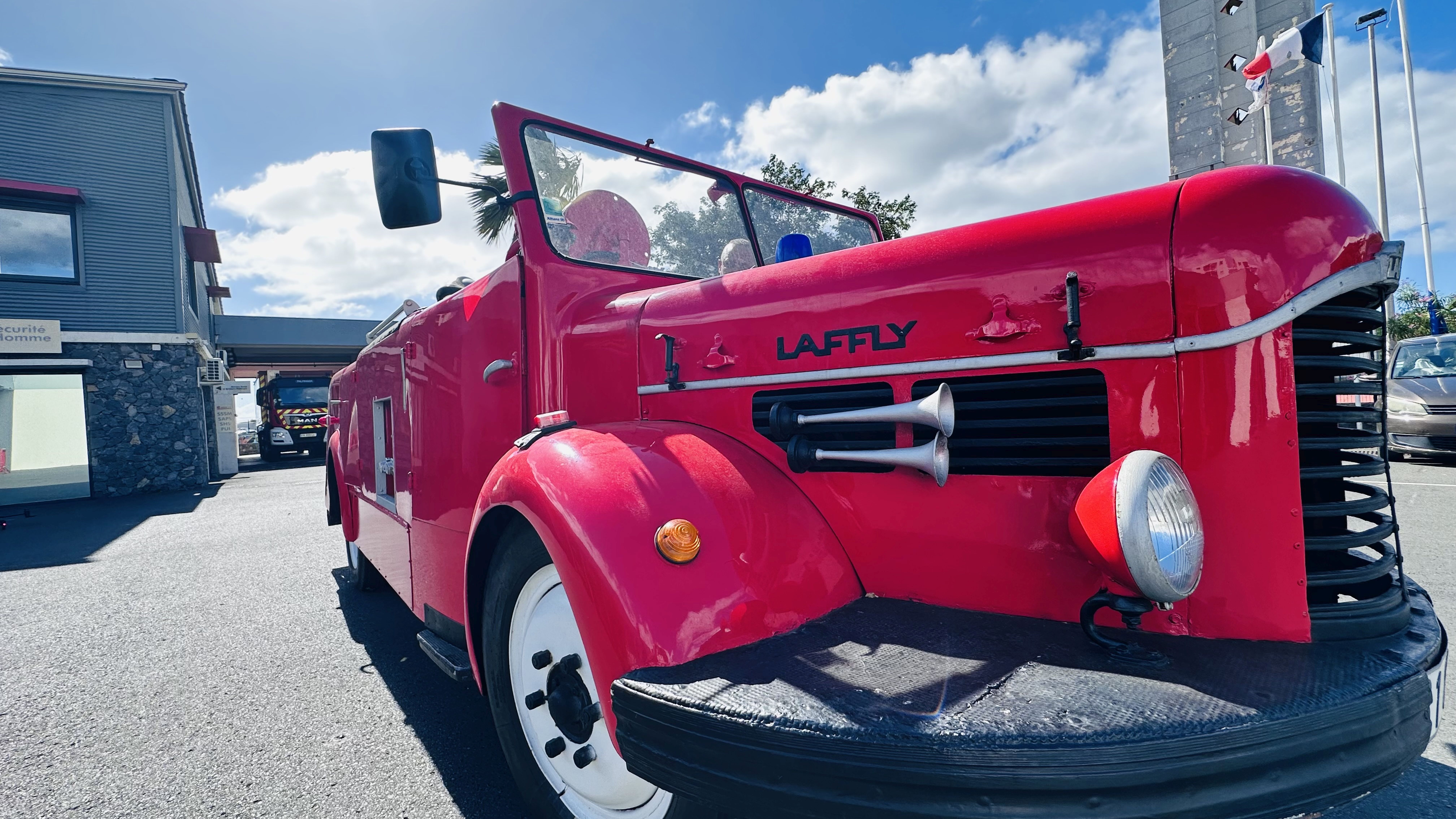
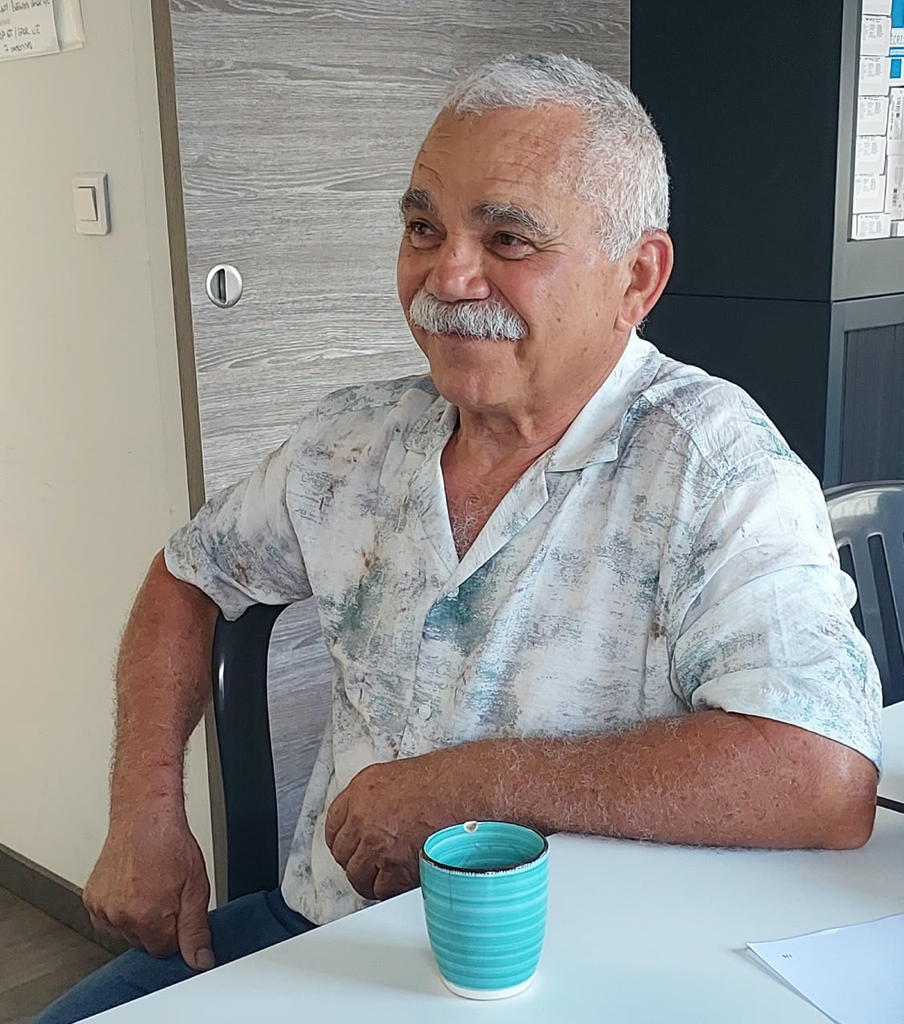
Built in 1950, the Laffly fire engine of the Saint-Denis fire brigade very nearly disappeared. In the 1990s, Pierre-Siméon Viadère set out to rescue the vehicle from the scrapyard. With the help of several colleagues, he gave it a second life, and it went on to lead the brigade in the island’s Bastille Day parades. An interview conducted on 17 November 2026 by Nicolas Folio, president of the Association des Amis du Musée des Sapeurs-Pompiers de La Réunion et de l’Océan Indien (Friends of the Firefighters’ Museum of La Réunion and the Indian Ocean), and Jean-Yves Pontiac now makes it possible to tell this little-known story.
Context. La Réunion is a French island in the Indian Ocean, about 700 km (430 miles) east of Madagascar and some 9,000 km (5,600 miles) from Paris. A colony until 1946, it then became a French département, with the same status as any region of mainland France. Saint-Denis is its capital. It should not be confused with the town of the same name near Paris. Until 2001, Saint-Denis had its own municipal fire brigade. That year the brigade was merged into the island-wide departmental fire and rescue service, the SDIS de La Réunion.
A witness to the motorization of firefighting
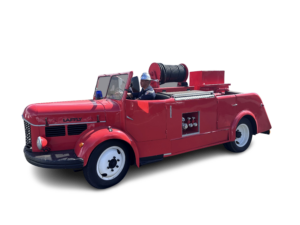
The vehicle was built in 1950 in Asnières-sur-Seine, near Paris, by Laffly, a French manufacturer of fire engines and military trucks. It is now protected as a historic monument. It reflects how La Réunion’s fire services became motorized after the Second World War, when the island was moving from colonial status to full integration into France.
A resolution passed by the Saint-Denis town council on 22 April 1955 lists among the brigade’s equipment a “Laffly first-response vehicle” (voiture de premier secours) with a 500-liter (130-gallon) water tank. The vehicle was therefore in service in Saint-Denis by 1955 at the latest.
This historical name differs from the one used today by the French Ministry of Culture, which classifies it as a “firefighting vehicle of the fourgon pompe-tonne type”, that is, a pumper carrying its own water tank.
The Laffly is 5.60 m long, 2 m wide and 2.15 m high including its hose reel (about 18 ft 4 in by 6 ft 7 in by 7 ft 1 in). It is one of the surviving material witnesses to how the island’s firefighting equipment evolved.
After it was withdrawn from operational service, the vehicle was kept in Saint-Denis. Its condition, however, deteriorated to the point where its survival was in doubt.
Pierre-Siméon Viadère takes the initiative
Pierre-Siméon Viadère was then in charge of the brigade’s vehicle fleet and workshop. When he came across the Laffly, stored in a corner of the garage, it was badly deteriorated.
The wooden parts had decayed, some of them eaten by termites. The equipment and the mechanical components needed major work. There was a real prospect that the vehicle would be scrapped.
Viadère knew how rare it was. As he recalls, it was at the time the only vehicle of its type on the island, and only around five comparable examples survived in mainland France.
He decided to save it.
The authorization he obtained from his superiors was minimal. He was allowed to carry out repairs, but there was no official restoration program and no dedicated resources.
He moved the truck to the back of the garage and worked on it whenever his duties allowed. He also gave up weekends and personal time to the project.
Other firefighters gradually joined in. In a written account sent to our association in August 2025, Jean-Yves Pontiac names, alongside Pierre-Siméon Viadère, Michel Esparon, Henri Mazellier and Henri Dijoux.
Henri Dijoux, a firefighter and a trained carpenter, helped rebuild the wooden seats, which termites had badly damaged.
Viadère’s initiative thus became a collective effort, drawing on the technical skills of several Saint-Denis firefighters.
A mechanical restoration spanning several years
Pierre-Siméon Viadère dates the main mechanical work to 1994 and 1995, with a further phase in 2002.
The work covered both the equipment and the components essential to the vehicle’s operation. The equipment lockers were rebuilt, the water tank was remade, and several mechanical parts were overhauled.
One of the main difficulties was the fuel supply.
The original fuel pump was no longer available, so Viadère and his team fitted an electric pump. This adaptation required a control box and relays to feed fuel to the engine, both on start-up and while running.
The braking system was another challenge. Like many vehicles of its era, the Laffly has mechanical brakes operated by cables and rods rather than hydraulics. Maintaining them requires careful dismantling, thorough cleaning and precise adjustment.
Viadère recalls in particular the trouble the vehicle had passing a roadworthiness inspection a few days before a Bastille Day parade.
The brakes failed the test, and the vehicle’s place in the ceremony was in jeopardy. Over a single weekend, he dismantled the rods and cables, then cleaned, brushed, sanded and greased every part before reassembling them.
On Monday morning, the Laffly went back for inspection. The brakes worked and the vehicle was declared roadworthy.
Other incidents marked this second career. Viadère mentions a broken drive shaft, among others, which took about two weeks to repair.
Back on the Barachois
The restoration carried out by Pierre-Siméon Viadère and his colleagues put the Laffly back on the road in the 1990s.
The vehicle then found a place in the ceremonies of the Saint-Denis fire brigade, above all in the 14 July parades on the Barachois. The 14th of July, known in English as Bastille Day, is France’s national holiday and is marked by military and civil parades. The Barachois is the seafront esplanade of Saint-Denis, where the city’s official ceremonies are held.
Jean-Yves Pontiac remembers this period well. He was then head of operations for the Saint-Denis fire brigade, under the command of Bruno Lautret. He suggested that the watch commanders, who lead each duty shift, take turns riding in the vehicle at the head of the firefighters’ contingent.
Gérard Grondin was among those who rode in it before his retirement.
Driving the Laffly, however, demanded intimate knowledge of the machine. Only a handful of experienced firefighters were used to taking the wheel. Viadère, for his part, firmly insisted that the vehicle should never leave his fire station.
His attachment to it comes through clearly when he talks about the years he spent maintaining it:
“It was more than a baby to me.” (« C’était plus qu’un bébé pour moi. »)
In his written account of August 2025, Jean-Yves Pontiac also tells an anecdote that shows the Laffly’s quirks. While firefighters had left the garage for lunch, the wheels had not been properly chocked, and the truck began to roll slowly across the yard. According to Pontiac, a colleague managed to stop it.
Pierre-Siméon Viadère retired in 2015. The vehicle he helped save remains one of the lasting traces of his career.
A museum idea ahead of its time
At the time of the rescue, a museum dedicated to vintage fire vehicles was already being considered.
Viadère remembers the idea, which came to nothing for lack of support.
The project shows that a heritage awareness existed well before our association was founded. Several firefighters had understood that old fire engines were not merely decommissioned equipment but witnesses to the history of their profession.
From rescue to official heritage protection
In France, objects of historical, artistic or technical value can be protected by the State as monuments historiques, a status that applies to movable objects as well as buildings. There are two levels of protection: classement (classification), the highest, and inscription (listing). The Laffly received the latter.
On 12 June 2024, our association formally applied for the Laffly to be listed, with the support of the SDIS de La Réunion.
The application was reviewed on 13 February 2025 by the Regional Heritage and Architecture Commission (Commission régionale du patrimoine et de l’architecture). The listing was then granted by order no. 1090 of 27 June 2025, issued by the Prefect, the State’s representative on the island.
The Laffly thus became the first firefighting vehicle in La Réunion to be listed as a historic monument.
This recognition gives new weight to the accounts of Pierre-Siméon Viadère and Jean-Yves Pontiac. They make it possible to document the successive changes made to the vehicle and to better understand how it was preserved.
The work carried out includes:
- rebuilding the equipment lockers;
- remaking the water tank;
- replacing the wooden seats;
- fitting an electric fuel pump and a relay box;
- modifying the wiring.
The water tank, originally used for firefighting, is now a dummy, and it is not known when this change was made.
These alterations are now part of the Laffly’s material history. They show the technical solutions chosen to keep it in working order, and they will have to be taken into account in any future restoration.
Under French heritage law, any alteration, repair or restoration of a listed object must first be notified to the State’s heritage services. This requires precise documentation, before any work begins, of the vehicle’s condition, its original components and the changes made over time.
The memories of former firefighters thus complement the technical and administrative archives. They contribute directly to the knowledge and preservation of the object.

A memory to pass on
The Laffly’s history cannot be reduced to its construction in 1950 and its listing as a historic monument in 2025.
It is also the story of Pierre-Siméon Viadère, who took the initiative to restore it; of the colleagues who worked alongside him; and of Jean-Yves Pontiac, who helped secure the vehicle’s place in the traditions of the Saint-Denis fire brigade.
Our association continues this work of remembrance by collecting testimonies, photographs and documents that trace the vehicle’s history.
The Laffly was saved from the scrapyard by firefighters who refused to let it disappear. It is now our association’s task to pass on their story as well.
Sources
- Interview with Pierre-Siméon Viadère, conducted by Nicolas Folio and Jean-Yves Pontiac, 17 November 2026. Oral archives of the AAMSPLROI.
- Written account by Jean-Yves Pontiac, 14 August 2025. AAMSPLROI archives.
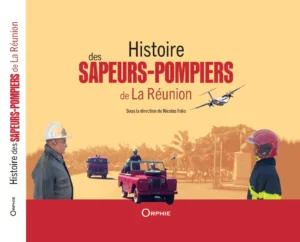
- Saint-Denis town council, resolution of 22 April 1955 on the creation of a fire brigade, reproduced in Histoire des sapeurs-pompiers de La Réunion (A History of the Firefighters of La Réunion), Éditions Orphie, 2025.
- AAMSPLROI, application for the listing of the Laffly as a historic monument, 12 June 2024.
- French Ministry of Culture, Palissy database (national inventory of protected movable heritage), record PM97400171, Véhicule de lutte contre l’incendie de type fourgon pompe-tonne, https://pop.culture.gouv.fr/notice/palissy/PM97400171.




Post Comment