Céline Fonder: anticipation to the power of ten
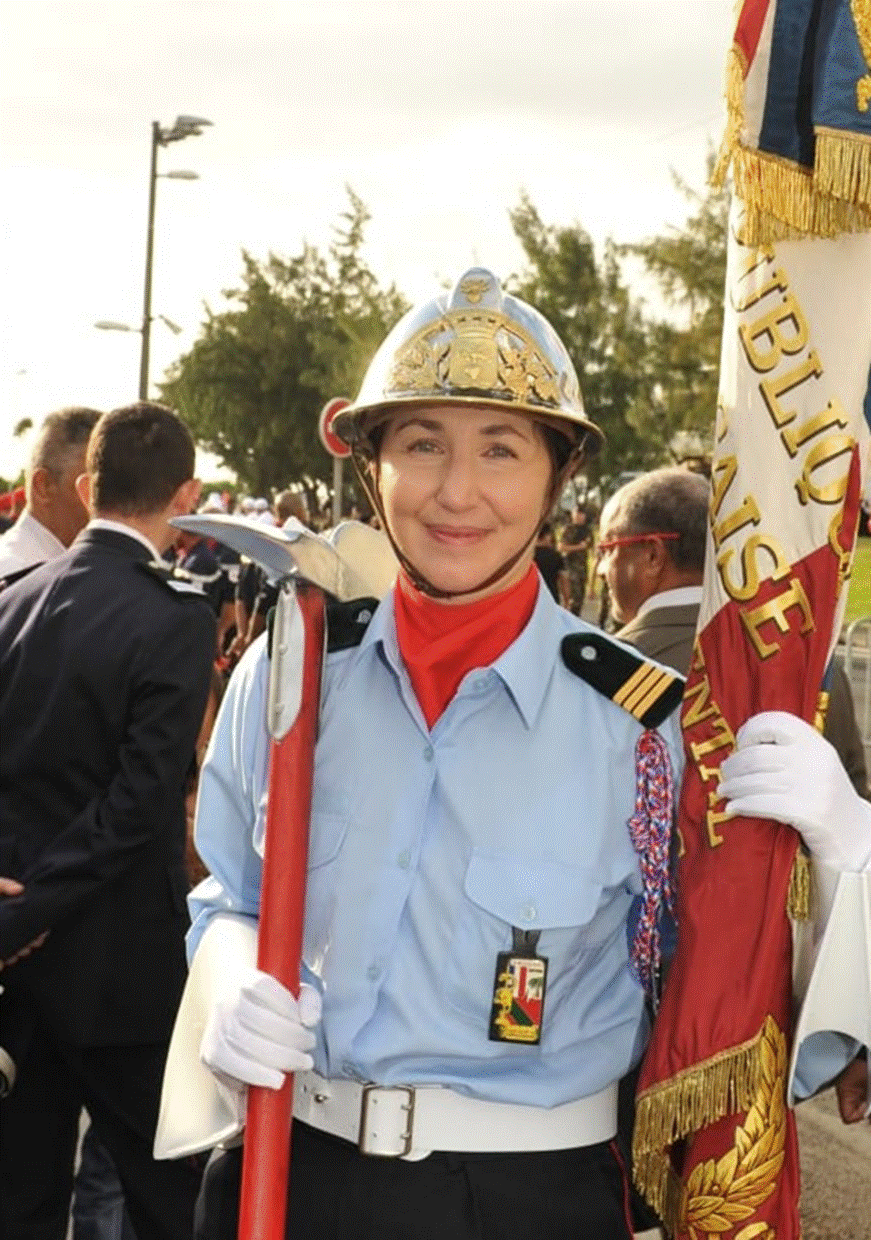
Lieutenant Colonel Céline Fonder joined the fire and rescue service (SDIS) of Réunion, the French island in the Indian Ocean, as a career pharmacist on 1 December 2008. She runs its in-house pharmacy. On an island where almost nothing is manufactured, she makes sure that medicines and rescue equipment arrive on time and never run out.
A pharmacy from another age
Her first placement as a pharmacy student was at the Dubois pharmacy in Monthermé, in the Ardennes, in north-eastern France. The shop had kept its original furniture and wood panelling, simply adapted to make room for computers. Céline Fonder looked through old prescription registers: one dated from 1923, another from 1959, which recorded a preparation made for her father when he was 3 years old.
She also discovered the old equipment of the compounding room: the porphyry slab, the pill cutter for rolls of pill mass, the cachet press, the suppository moulds. The skill she gained there later earned her a part-time job in a pharmacy in Pierry, near Épernay, from the end of her third year of studies to her sixth.
A thesis in parasitology
For the thesis that completes French pharmacy studies, she wanted a partly experimental subject. She first thought of toxicology; in the end, the parasitology laboratory offered her a project. The aim was to develop molecular biology tests to identify the eggs of intestinal parasites in wild and domestic ruminants. The species of these worms can only be identified at the adult stage, that is, when the host animal is dissected. A PCR test on faeces makes it possible to identify them at the egg stage, and so to study transmission between wild and domestic ruminants.
The work involved obtaining DNA sequences by PCR and molecular cloning, designing and ordering the primers, then testing the new assays on samples from roe deer, red deer and cattle. In 2003, her thesis jury included Gérard Grandidier, a veterinary firefighter with the Ardennes fire and rescue service and one of the founding members of the ANVSP, the French association of veterinary firefighters, “at a time when I didn’t even imagine there could be pharmacists in fire and rescue services!”
From one pharmacy to another
She then worked in several community pharmacies, as an assistant pharmacist or a locum. Software, storage and habits changed from one shop to the next; sometimes the patients stayed the same. Some found it amusing: “Oh, you work here too! That suits us: we can change pharmacy and still have the same pharmacist!” Others went a few kilometres further for more discretion. That period, she says, shaped her ability to adapt.
From Mayotte to the fire service
At the end of 2006, a professional project came to an end. Before starting another, she decided to “see the world”: two months in Mayotte, the French island in the Comoros archipelago, in 2007, then Réunion. At a pharmacists’ conference, she heard that the fire service pharmacist was looking for someone to cover his holidays. That is how she met Christian Bosserelle, whom she replaced on a temporary contract in January 2008.
She also joined as a volunteer firefighter. She enjoyed the work, passed the competitive examination for career fire service pharmacists in March 2008 and was recruited on 1 December 2008. The in-house pharmacy of the SDIS was still very new: it had received its licence in May 2006 and therefore turns 20 this year.
From the request to the patient
An in-house pharmacy (pharmacie à usage intérieur, PUI) supplies medicines and medical devices. It is also responsible for the quality and safety of the whole chain, from the moment a need is expressed to the moment the product is given to a patient. Unlike a community pharmacy, which deals directly with patients, its work extends well beyond its own walls.
In the SDIS, as in many French departments, the role has grown to cover first-aid and medical equipment, biomedical devices and all the equipment used for emergency medical care and fitness-for-duty medical checks, often under a “single service” approach. The supply chain must also hold up in a crisis, whether planned or not: “The pharmacist has to adapt very quickly and rapidly propose a new organisation to deal with an exceptional situation… while still handling the routine!”
Island constraints
In Réunion almost nothing is manufactured locally, and local suppliers, who hold little stock, face the same shipping delays. Céline Fonder therefore combines local and overseas suppliers and keeps intermediaries to a minimum: to control costs, but above all to shorten delivery times and obtain longer expiry dates.
The pharmacy receives several months’ worth of stock at once, which has to be checked and stored. It needs suitable space to absorb these large deliveries and to prepare internal orders and batch management. Enlarged in 2009 on the Monthyon site, it moved to the Tadar site in 2015. Freight forwarders play a decisive role: a reliable forwarder saves long hours of emails and phone calls to release an urgent delivery.
A cross-cutting responsibility
Asked about management, her first answer is: “Complex subject… pass!” She has few staff under her, compared with a fire station. But the responsibility of the pharmacist in charge for the quality and safety of the medicines chain requires many working relationships with other departments, which are gradually growing stronger.
Chido, seen from Réunion
She does not single out a particular operation: “We are so far from operations…” Her most recent memory is the Chido mission in Mayotte. Staying in Réunion, she followed the team deployed there: anticipating the resources that might run short, planning fallback solutions, organising resupply, building contacts remotely and putting people in touch, “which is possible when communications work!”
Fire service pharmacists from mainland France then took turns on site, finding it very hard to set up that supply “chain”. In mainland France, the pharmacies of neighbouring fire services can send stock to one under strain. In Mayotte, that local solidarity does not exist. Emergency kits work before, during and in the first days of a crisis; if it lasts, they are no longer enough, and a dedicated supply chain has to be built.
The same job
Throughout her career, she has held posts in which the pharmacist is legally responsible for an establishment: a community pharmacy, an in-house pharmacy, a laboratory. In French, job titles and ranks can take a masculine or a feminine form, and she sees no point in using the feminine: historically, it meant “the wife of…”. “So I feel more of a pharmacien (with a degree) than a pharmacienne. And whether you are a man or a woman, you do the same job!”
She points out that the first women doctors and pharmacists qualified at the end of the 19th century. Today, medical students are almost evenly split between men and women, and two-thirds of pharmacy students are women. Gaps appear later, in the choice of specialties and in university hospital posts, which are mostly held by men. She wonders whether family life still weighs on the choice of a specialty or of a competitive examination, and concludes: “So, ladies, dare to sit the examinations and take the posts!”
“When a man is ‘rigorous and organised’, a woman is often called ‘rigid’ for the same qualities…”
Her advice
To a student or young pharmacy graduate considering a fire and rescue service: “Go for it!” The work is varied. For community pharmacists who join as volunteers, it is a chance to discover how an establishment is organised. The job calls on expertise and means drawing again on knowledge of chemistry, physics, toxicology, parasitology and biology, particularly for CBRN risks.
Key dates
- 2003: thesis in parasitology.
- May 2006: licence granted to the in-house pharmacy of the Réunion fire and rescue service.
- 2007: two months in Mayotte, then arrival in Réunion.
- January 2008: temporary replacement of the fire service pharmacist; joins as a volunteer.
- March 2008: competitive examination for career fire service pharmacists.
- 1 December 2008: recruited by the Réunion fire and rescue service.
- 2009 and 2015: pharmacy enlarged at Monthyon, then moved to the Tadar site.
Acronyms
- ANVSP: French national association of veterinary firefighters.
- CBRN: chemical, biological, radiological and nuclear.
- PUI: in-house pharmacy (pharmacie à usage intérieur).
- SDIS: departmental fire and rescue service (service départemental d’incendie et de secours).
This portrait is part of an online series that extends the feature “1976–2026: 50 years of women’s commitment” in Ligne de vie No. 1 (English edition), the historical review of the Friends of the Firefighters’ Museum of Réunion and the Indian Ocean. All portraits in the series are gathered on the Femmes des secours page (in French). Testimony collected in writing in November 2026 and translated from French. To share a testimony, in English or French: lignedevie@lemuseedespompiers.re.


Post Comment